


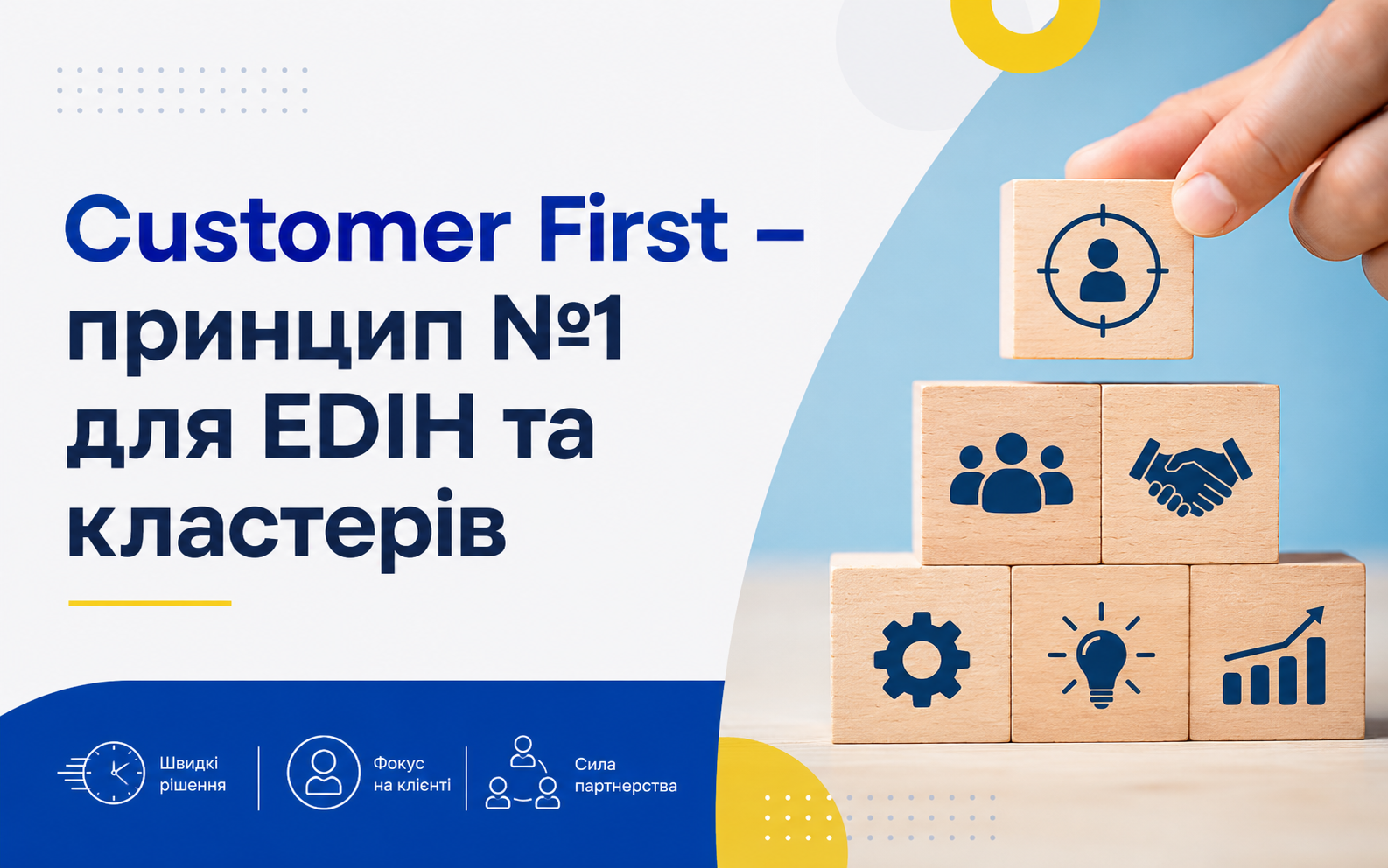

Any organization sooner or later makes a choice. Build a system around yourself – or build a system around customers. First of all, our SMEs – because it appears in the mandate of both clusters and EDIH. A real focus on the customer – that’s what distinguishes client-centric organization from self-centric. However, sometimes it is difficult to notice this difference – because in words and in declarations it sounds about the same. In practice, these are two completely different ways of thinking.
Self-centricity sounds like this
‘First we will agree on the rules. We still need to identify those responsible.
But we haven’t set up our services enough…”
‘No, it looks raw – let’s hold an internal meeting. We need to refine the interaction formats…”
‘Listen, you do not take into account the motivation of our experts – and they are clearly not motivated …’
‘But stop – is it our competence? – This is the service of another partner. And in general, without a quality procedure there will be chaos. Everyone needs to fill in the matrix of services and solutions…
…and it all drags on for weeks and months, because in the center of everything is the organization itself – not a client!
Customer First sounds different
There is a request from the company. Who can help today? If this is not our service, we will find someone who can. Otherwise, why do we declare ourselves ecosystem coordinators or orchestrators? The rules will be polished later.
No ready solution? – Gather the team. Don’t know the answer? – Let’s find it in the community!
Customer First is when every request has an owner, in the center is always a customer’s problem. Everything else is secondary.
This is clearly seen in simple examples
Speed of processing leads and willingness to take responsibility
- Self-centricity: the lead lies for two weeks, and the team is currently discussing the rules of working with ice.
- Customer First: lead got a responsible person in an hour. The rules are finalized after the client has been helped.
What is in the focus of discussions
- Self-centricity. Experts constantly talk about their own services. about (umder) motivation. about the limitations of the system (especially noticeable in universities).
- Customer First. Experts start with the question – ‘What problem of the company are we ready to solve now? Who will take the lead?’
Reaction to offline events
- Self-centricity: an offline event for experts is an ‘additional burden’. – ‘We don’t have time for that.’
- Customer First: An offline event is an opportunity to hear and understand the client before he ordained a technical task.
Responsibility for the decision
- Self-centricity: ‘This is not our area.’ (we do not have this expertise)
- Customer First: ‘We know who can help.’
The use of A.I.
- Self-centricity: ‘Let’s have another iteration of the expert interaction procedure – we have not yet taken into account this factor X’
- Customer First: ‘I’ll try another iteration in business case profiling, because it looks a little superficial, and I need come to the right questions ‘And what exactly should I ask this, a particular client.’
After any meeting, the team should ask themselves the question – ‘How can we improve the state of our client’s affairs tomorrow?’. If the answer is obvious, we are moving correctly.
If the answer sounds like – We agree on the document We are clarifying the process of interaction We are creating a working group We have identified the responsible – This is not a value for the client. It’s just preparing for it.
What it means for EDIH or innovation cluster
Each ice is not an entry in the register (CRM or Google tables – it doesn’t matter). This is a real enterprise, real, concrete, Ukrainian director, who has already spent his time and trust by contacting us.
Every day, unanswered demand, does not work against our perfect model of innovative support. But he definitely works against trust.
So in the end, the question is simple. Do we understand that trust is the most valuable asset of any service organization?
Summarizing all of the above. The principle of the customer first – means a simple thing. We do not build a system to make it convenient for us. We build it so that our customers, SMEs, can easily get the right solution – no matter who provides it.
Because in the center of the EDIH or the innovation cluster is not a service. not the KRI system. Not a report for the European Commission. Not a partner. Not a university. Not another grant. There should always be a client in the center.
Yurchak Oleksandr, CEO UCA