


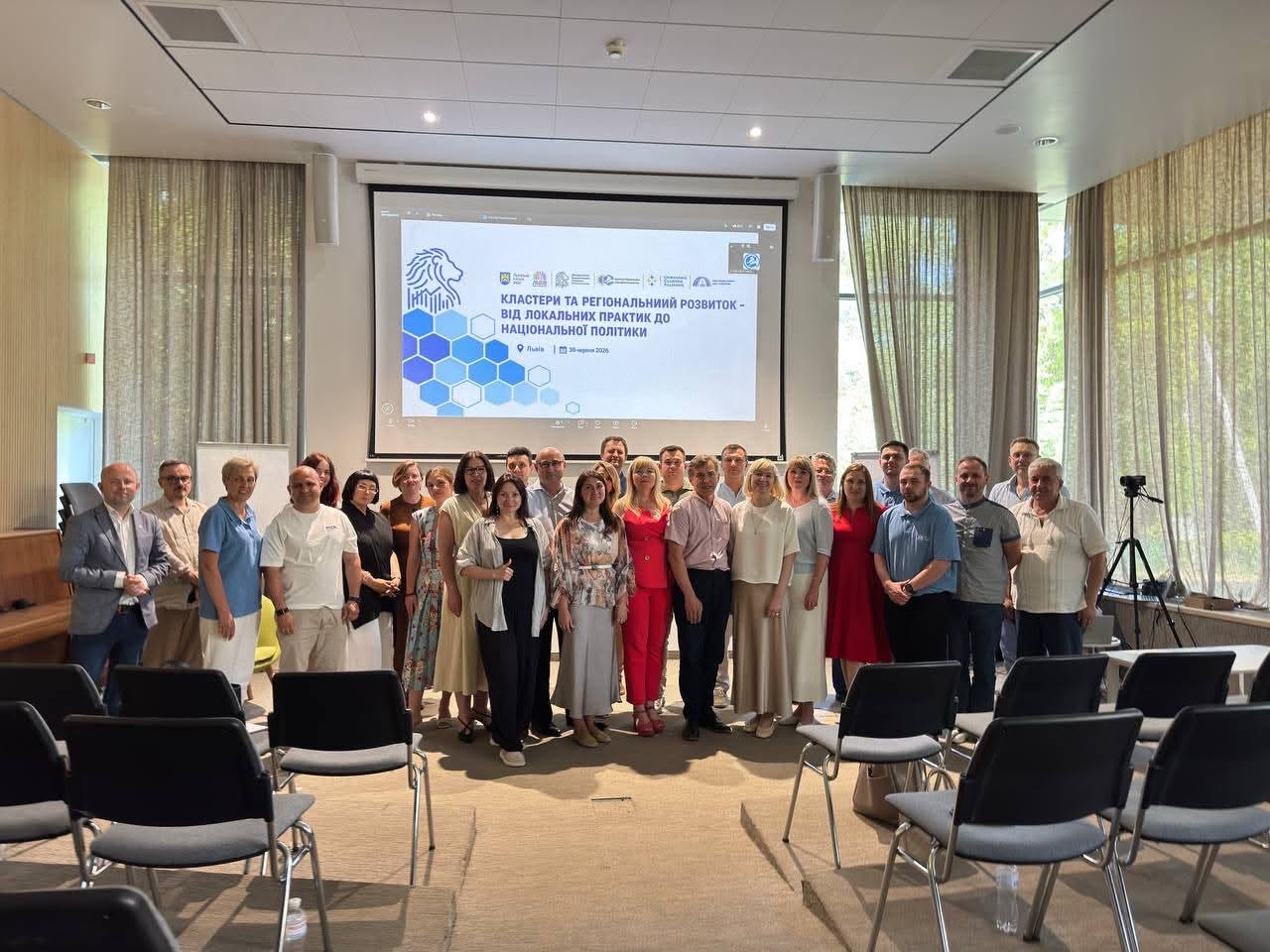
Clusters and Regional Development: From Local Practices to National Policy

Report on the Cluster Conference in Lviv on June 30
On June 30, Lviv hosted the conference “Clusters and Regional Development: From Local Practices to National Policy,” organized by the Department of Economic Development of the Lviv City Council in collaboration with the Ukrainian Cluster Alliance.
The event brought together representatives of central and local government, regional development agencies, clusters, international experts, the business community, and the academic community. Representatives from more than ten regions of Ukraine participated in the conference, as well as experts from the ACCIÓ agency (Catalonia), who shared one of Europe’s most successful examples of cluster policy development.
However, the main value of the conference lay not so much in learning about specific practices as in the opportunity to see how a new, multi-level model of cluster policy is gradually taking shape in Ukraine.


Context of the event: From individual projects and initiatives to systemic policies
Just a few years ago, the development of clusters in Ukraine was associated primarily with individual international projects or initiatives by active business communities.
Today, the situation is gradually changing. During the conference, three interrelated levels of cluster policy development were presented for the first time within a single framework:
-
-
national — the draft Concept for the Development of Clusters in Ukraine, which is being developed by the Ministry of Economy in collaboration with the Ukrainian Cluster Alliance;
-
regional — the results of the Clusters4Regions project, under which six regions of Ukraine have already approved their own cluster support programs;
-
local — the new Program for the Development of Cluster Policy in the Lviv City Territorial Community for 2026–2028 is the first of its kind in Ukraine to demonstrate the role of local self-government bodies (LSGBs) in cluster development.
-
In fact, Ukraine is moving from the experimental stage to the establishment of a system of multilevel governance, in which national, regional, and municipal policies are intended to reinforce one another.
Lviv Sets a New Standard for Municipal Cluster Policy
One of the highlights of the conference was the presentation of the new Cluster Policy Development Program for the Lviv City Territorial Community.
Its fundamental difference lies in a shift in the very philosophy of the city’s economic policy. While the traditional approach focused primarily on supporting specific categories of small and medium-sized enterprises (SMEs), the new program proposes a shift toward developing entire innovation ecosystems through clusters.
For the first time, the program systematically combines the development of cluster ecosystems with a focus on innovation, the city’s smart specialization priorities, the Shared Value approach, avenues for integrating science, education, business, and government, as well as the international integration of clusters.
It is particularly noteworthy that the city views cluster policy not as a separate business support program, but as one of the key tools for implementing its own economic strategy.
The program also outlines a clear logic for cluster development—from building a cluster ecosystem and supporting early-stage initiatives to scaling up mature clusters through international partnerships. At the same time, the assessment of its effectiveness is based not only on the number of events held, but primarily on the changes achieved in the development of the cluster ecosystem and the long-term economic impact.
It is precisely this approach that aligns with the best European practices today.
Practices That Already Work
A separate session of the conference was devoted to practical case studies of Ukrainian clusters.
Participants presented examples that are already showing measurable results:
-
-
IRON Cluster — the development of Ukraine’s largest defense technology ecosystem, which already brings together more than 120 companies and startups and focuses on testing, acceleration, attracting investment, and engaging with the government.
-
The Rivne Region Furniture Cluster — an example of how a regional development agency can act as a cluster development operator and integrate the cluster into international projects.
-
The Lviv Furniture Cluster — practices for export development, preparing companies to meet EU requirements, and building trust among competitors.
-
The Lviv Medical Business Cluster — the development of an ecosystem of medical services, innovation, and medical tourism.
-
All of these examples have once again confirmed that a successful cluster today is not so much about a local association of businesses (one of many that exist) as it is about a professional operator dedicated to the development of an entire economic sector—a specific industrial ecosystem.
Shared Value — A New Philosophy of Cluster Development
A key part of the conference was the presentation by Alberto Pecci, Director of Development at the ACCIÓ agency (Catalonia), who shared one of the most successful examples of cluster policy implementation in Europe. The Catalan experience once again confirmed that the long-term success of clusters is ensured not by individual grants or projects, but by a stable development policy, professional cluster management, and systematic interaction between business, academia, and government.
A joint presentation by Nadiya Karplyuk and Oleksandr Yurchak on the concept of Creating Shared Value (CSV) served as a follow-up to Alberto’s speech. The presentation demonstrated that modern clusters not only generate economic benefits for their participants but also create social value through the development of human capital, innovation, regional ecosystems, and national resilience. Particular attention was paid to the Ukrainian adaptation of the CSV concept, which supplements the classic European ESG model with a fourth dimension—security and resilience. It is precisely this approach that is increasingly shaping the development of Ukrainian clusters amid the war and during post-war recovery.
Group Work: From Problems to a Shared Agenda
The conference concluded with an interactive “World Café” session, during which participants worked in mixed groups. The teams rotated through three thematic discussion stations, gradually building on the work of the previous groups. This format allowed participants not only to gather a wide range of opinions but also to develop a shared vision of the key challenges and priorities for the development of Ukraine’s cluster ecosystem.
The first station focused on the key barriers to cluster development and the tools for overcoming them. Among the main challenges, participants cited low levels of trust among businesses, insufficient understanding of the benefits of the cluster model, weak institutional capacity of young clusters, a shortage of professional cluster managers, the absence of long-term development strategies, and insufficient involvement of large companies. In response to these challenges, participants proposed the development of training programs for cluster managers, mentorship from mature clusters, systematic communication and promotion of the cluster movement, B2B networking, transparent governance rules, and support for business leaders willing to serve as drivers of new cluster initiatives.
The second session focused on the solutions that participants expect from the national government and local authorities. The proposals that received the most support included finalizing the national cluster policy, launching sustainable funding mechanisms at all levels, creating a National Register of Clusters, developing training programs for cluster managers, strengthening coordination between government programs and international donors, supporting technology transfer, and fostering ongoing dialogue between government, business, education, and science.
The third session focused on best practices that are already demonstrating the effectiveness of the cluster approach. Participants identified the following as the most promising areas: the development of shared innovation and technology infrastructure, inter-cluster cooperation platforms, joint research projects, technology transfer, workforce retraining programs, international business missions, export initiatives, joint promotion of Ukrainian manufacturers, inter-cluster hackathons, study visits to successful European clusters, the development of the Creating Shared Value (CSV) approach, and the formulation of local and regional cluster policies as the foundation for long-term economic development.
Thus, the results of the “World Café” session confirmed the conference’s main conclusion: the development of clusters requires simultaneous efforts on three levels—the professional development of the clusters themselves, systematic support from state and local authorities, and the active sharing of best practices among regions.
Conclusions and Next Steps
One of the most important conclusions of the conference was the realization that the very logic behind the development of cluster policy is, in fact, changing in Ukraine today.
While just a few years ago the key question was “How do we create a new cluster?”, today another question is becoming increasingly relevant:
how to create an environment in which strong clusters can systematically emerge, grow, and scale.
That is precisely why policies that foster not individual organizations but entire innovation ecosystems are becoming increasingly important.
Lviv today offers one of the most consistent examples of this approach. The Clusters4Regions regional programs demonstrate the potential for scaling it up at the regional level. The next logical step should be to finalize the national framework for cluster policy and launch a permanent coordination mechanism between the central government, regions, and local communities.
It is precisely this multilevel system that will form the foundation for the competitiveness of the Ukrainian economy during the post-war recovery and integration into the European economic space.
The Executive Directorate of the UCA sincerely thanks the leadership of the Lviv City Council for its long-standing partnership in the development of clusters, and for this event, which sets a new standard for cooperation between communities and clusters across all regions of Ukraine.