


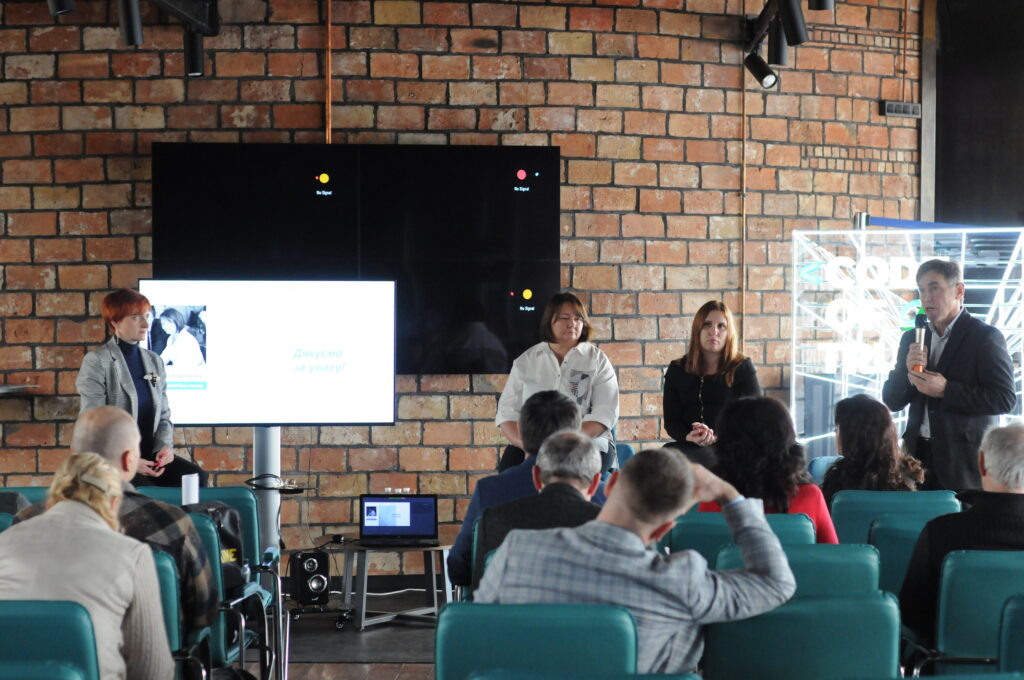
The Ukrainian Cluster Alliance (UCA) annual conference took place in Kyiv on January 30. Over 70 representatives of clusters, international organizations, regional development agencies, and other partners involved in cluster development in Ukraine attended. As in previous years, the conference focused on sharing best practices and discussing joint development directions for 2025.
2024 Highlights
In his speech summarizing 2024, UCA CEO Oleksandr Yurchak highlighted the key achievements of clusters in five key areas:
- Capacity building: UCA doubled its membership, conducted three ESCA certifications, and continued consolidating community members into joint structural units (two Resource Centers, two Committees, and 12 Working Groups).
- Project activities: UCA increased its total development funds to €490k (a twofold increase), raised the average number of ongoing projects to ten, and transitioned its Project Office to medium-term Clusters programs. The first to launch was the Clusters4Defense program.
- Cluster movement advocacy: Two projects launched in 2024—Accelerate GDT and Clusters4Regions (UCORD)—are reshaping relations with national and regional authorities and paving the way for the first national and regional cluster programs.
- Internationalization: Despite the lack of targeted donor funding for international travel, UCA expanded its internationalization efforts—achieving growth in business missions, new country partnerships, and the opening of new offices in the Czech Republic and Ireland.
- SME twin transition: UCA made significant progress in this area through two flagship projects: the first sectoral twin transition roadmap for the textile industry and the integration of clusters into the EDIH network, where five UCA clusters are leading consortia.
The full presentation of the 2024 results and 2025 priorities of the UCA Executive Directorate, along with a more detailed overview of the UCA Annual Report, is available at the following link.
Best Practices in 2024
UCA has traditionally monitored and documented the best practices of clusters and the entire community in several key areas. This year, our presentations and discussions focused on:
1. Collaboration with the government, regional development agencies, and municipalities in creating national, regional, and local cluster policies
Two UCA projects—Accelerate GDT and Clusters4Regions (UCORD)—are becoming flagship initiatives for the entire cluster movement in Ukraine. They will enable the creation of national and regional cluster policies (for six pilot regions). This is something clusters have dreamed of for many years—before 2025, Ukraine had no active state cluster policies. All leading UCA experts in the Committee on Cluster Policies and Innovation are already involved in these projects. A significant new development in 2025 is that UCA will co-develop these programs with regional development agencies (RDAs), bringing many new partners into the fold.
2. Integration into regional and sectoral development programs in line with smart specialization priorities
These issues were briefly raised in the final conference discussion and will undoubtedly remain relevant within the UCORD project and other regional initiatives. The methodology for developing regional cluster policies will be available to all clusters, allowing other regions to adopt and implement it. In this methodology, smart specialization priorities will be one of the key criteria for analyzing cluster potential and selecting target clusters.
3. Cluster Management Standards
The conference featured extensive discussions on this topic, which the cluster community began widely debating in February 2024. Key issues included membership fee models and how to implement them, multi-level membership structures, scaling models (10 vs. 100+ members require different approaches), cluster manager skills and qualifications, governance roles, and more. These issues were discussed further with individual clusters after the conference, as they are essential for understanding how to launch and scale a cluster. The EU4Digital program and the January 2024 public discussions on the seven growth tracks provided valuable analytics, leading to concrete recommendations on how clusters should move forward.
4. Development of Shared Resource Centers (SRCs) – Inter-cluster collaboration and joint projects
This remains one of the most pressing issues for UCA. CEO Oleksandr Yurchak noted that only two of the five SRCs are fully operational. Almost all structural units—including two committees and seven Working Groups (WGs) of the CoP 5.0 community—except for the Medical Clusters SRC—are under the direct management of the UCA Executive Directorate. The initial vision was to delegate governance and decision-making to cluster leaders, but this has not yet been realized.
Annual surveys conducted by UCA show that the primary reason for low engagement in managing structural units is a lack of resources—clusters struggle to allocate personnel even for their internal tasks, making it difficult to contribute to shared initiatives. However, if we set aside governance structure issues, collective work will continue to grow, and the number of joint projects within UCA increased in 2024. These projects include GDT Textile, EU-Ukraine Cluster Partnership, Clusters4Regions, DanubIA, and New applications developed by the CoP 5.0 Working Groups.
5. New Services for Cluster Members, SMEs, and High-Value Activities
UCA regularly evaluates clusters based on their service offerings for SMEs, as this is a key European (ESCA) and UCA membership criterion. Notable high-value services mentioned at the conference included:
- Despite being only a year old, shared order distribution, bulk procurement, joint exhibitions, and trade missions abroad – Thermal ENERGY CLUSTER OF Ukraine is actively implementing these services for SMEs. Joint exhibitions remain a core activity for many UCA clusters, with the Ukrainian Association of Furniture Manufacturers (UAFM) achieving the highest export figures.
- Talent development initiatives – Leading clusters include the Podillya Fashion Cluster and UAFM, both of which have launched vocational training programs. The Kharkiv IT Cluster, Ukraine’s largest IT cluster, addresses workforce challenges through broad cooperation with universities.
- Industry-specialized services – Lviv Tech cluster (IRON) provides members access to the Brave1 accelerator and defense industry certification services.
- Regular exchanges with European partners and business missions – Practiced by APPAU, Lviv Cluster of Medical Business, and Rivne Interregional Medical Cluster, these efforts build international consortia and long-term partnerships.
6. Internationalization of Clusters and Their Participants
A dedicated panel on this topic showcased various paths to internationalization. While UAFM is the undisputed leader within UCA regarding pure product exports, the integration into global value chains (GVCs) and international innovation projects is progressing more slowly. However, in some cases, it provides a more sustainable method for entering new markets. Regular exchanges with European partners and business missions organized by APPAU, the Lviv Cluster of Medical Business, and the Rivne Interregional Medical Cluster lead to international consortia, long-term relationships, and partnerships—a different approach to internationalization. For example, under the IDEALIST project (Horizon Europe), APPAU offers its members connections with leading European clusters, free training on key twin transition topics, and even covers travel costs for selected locations and events in the EU.
7. A Separate Sustainability Agenda for Frontline Regions
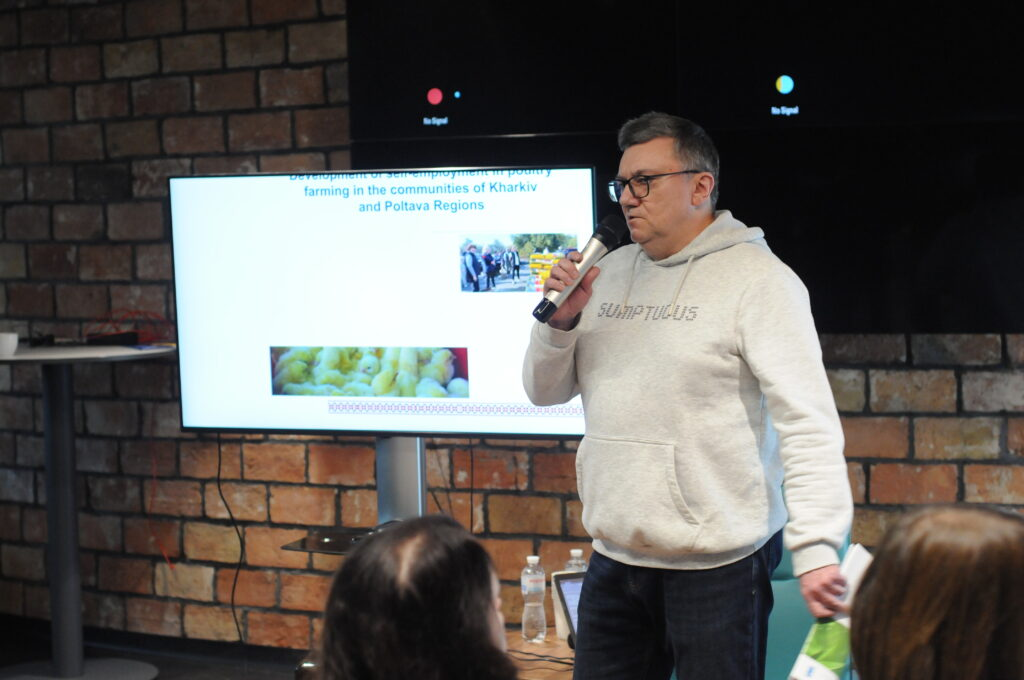
Vadym Shiyan from the Interregional Union of Poultry Breeders and Fodder Producers of Ukraine raised this point during his presentation on the “Veterinarians Without Borders” project, which has provided entrepreneurship development services and covered initial business expenses for over 400 entrepreneurs in Kharkiv Oblast. These initiatives have both economic and social value, as they help retain people in frontline regions and stimulate economic activity. However, there is a clear shortage of such projects, and discussions with clusters from Kharkiv and Zaporizhzhia highlighted the need to formulate these issues into a dedicated package for frontline regions and elevate them to a higher level of representation.
8. Acceleration of the Twin Transition for SMEs, with a Focus on Collaboration with EDIHs and Universities
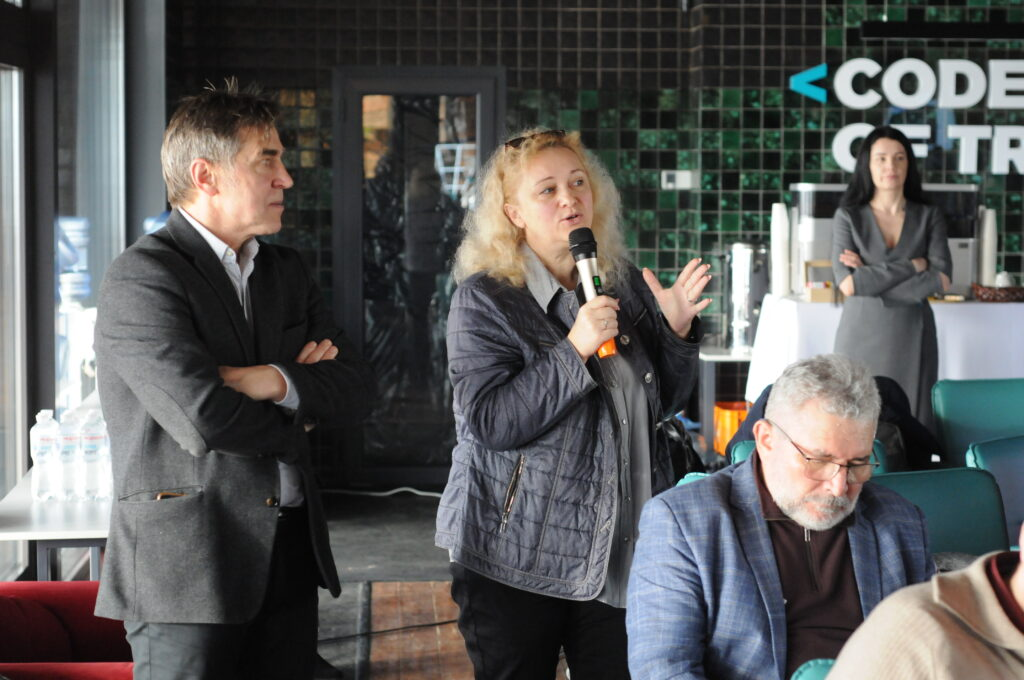
The headline projects for UCA in this area are GDT Textile and UCA’s consortia with EDIHs. While the next steps for GDT Textile are relatively straightforward, the situation with the EDIH network is far more complicated. The most pressing issue is funding, affecting not only unfunded consortia like EDIH Kyiv Hitech but even those that have received financial support. The funding model proposed by the European Commission is essentially a copy-paste from the EU, where such consortia are co-financed by local and national budgets. The reason for applying this model to Ukraine remains unclear, but domestic sources must equally match every euro spent by an EDIH from EU funds.
Olga Shapoval, CEO of the Kharkiv IT Cluster and Head of the Eastern Ukrainian EDIH Consortium, stated that finding a solution is far from straightforward. Similarly, clusters are unsure how to structure service provision for SMEs through EDIHs, mainly when relying on university resources. Structural changes within universities are a prerequisite for making this collaboration effective.
9. Developing a Common Agenda for Industrial Parks (IPs) Together with Partners
Ahead of the conference, UCA established a new Working Group (WG) to cooperate with Industrial Parks, led by Viacheslav Dyomin, Head of the Cluster of manufacturers of medical products Cluster “ProMedMan”. Viacheslav and other colleagues raised concerns about manufacturing enterprises’ low occupancy rates of industrial parks.
The WG proposed three key actions:
- Conducting a market survey on the current composition of IPs and the challenges in attracting manufacturing SMEs.
- Establishing regular exchanges and improving cluster engagement within industrial parks.
- Joint lobbying for legislative or policy changes at the government level, if necessary.
10. Fundraising and Engagement with Donors and International Organizations
The sustainable growth of UCA and its clusters would not be possible without donor support. UCA CEO Oleksandr Yurchak expressed gratitude to all donors who have supported UCA and its clusters over the past three years, including GIZ, USAID, UNDP, UNIDO, the Renaissance Foundation, UCORD, and various European programs. The Czech Republic and Norway government programs have also financed certain business missions. At the same time, many clusters are struggling to find financial opportunities, indicating the absence of a large-scale, medium-term cluster support program in Ukraine.
The most pressing funding issue right now is internationalization. Ukrainian clusters have only recently begun active exchanges with EU clusters, but these partnerships need ongoing financial support.
Goals and Priorities for 2025
UCA’s 2025 development roadmap can be found in the Executive Directorate’s presentation.
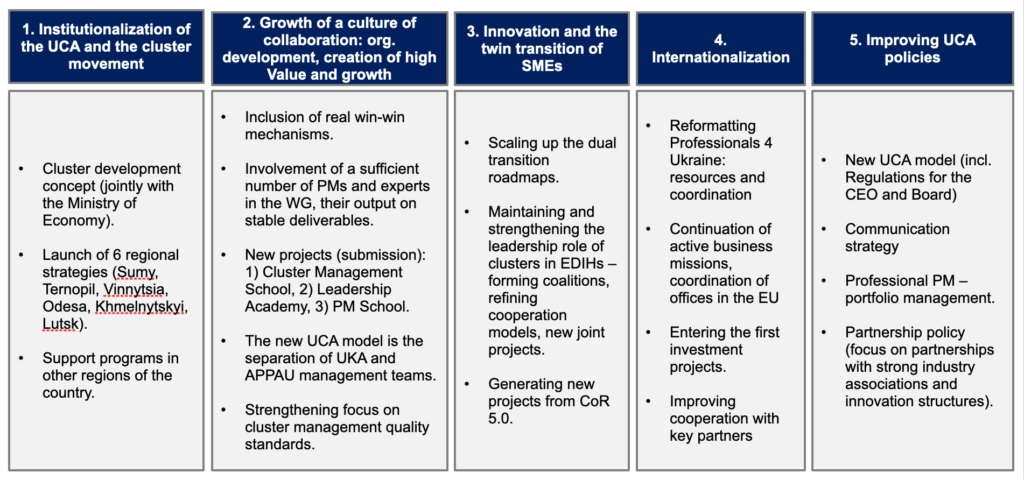
The institutionalization projects Accelerate GDT and Clusters4Regions, which have secured financial support, will become real drivers of change for many clusters and regions across the country. There are no grants yet for Direction 3 (twin transition), but the groundwork and prerequisites are promising, so we believe that new projects are just a matter of time. Similarly, tasks in Category 5 (policy changes) are neither complex nor require significant funding.

The biggest challenges for UCA in 2025 are Category 2 (Improving the Culture of Cooperation) and Category 5 (Internationalization). In Category 2, a key priority is launching new schools for cluster coordinators and, separately, the Leadership Academy. The lack of qualified personnel and leadership to address market challenges remains critical for UCA clusters’ development. As for internationalization, despite all previous efforts, there is still no stable financial support for travel, conferences, exhibitions, etc. This applies to both the Executive Directorate and 90% of our clusters and their members. Therefore, securing funding for these activities is a top priority for cluster leaders and our project office.
The Executive Directorate sincerely thanks all clusters and partners who participated in the conference on January 30. The first feedback from participants highlights the usefulness of these exchanges and the need for more frequent, in-person discussions. UCA plans to hold similar nationwide conferences at least twice a year.
Executive Directorate of the UCA