


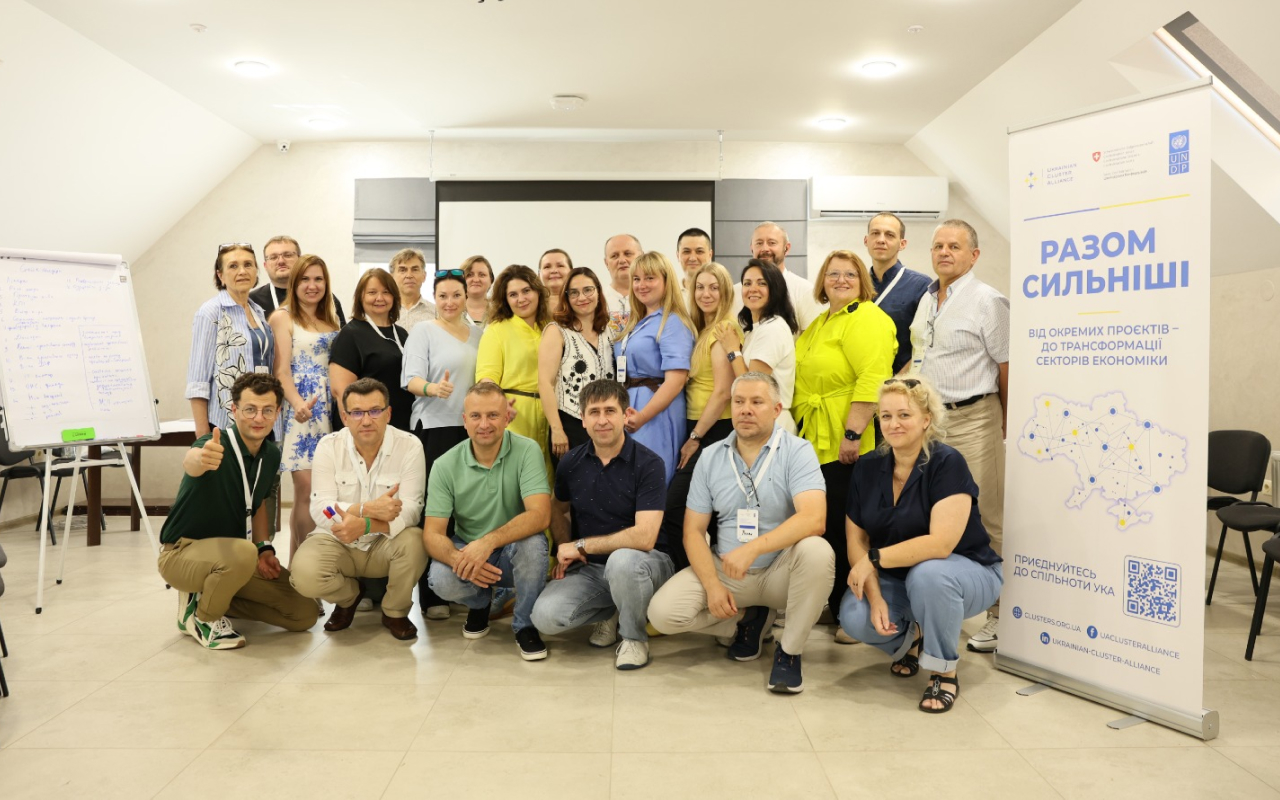

Report from the Strategic Session June 26-27
On June 26-27, the first two-day offline strategic session of the Ukrainian Cluster Alliance took place in Truskavets, uniting 20 clusters from more than 10 regions of Ukraine. The event became an important stage in the transition of UCA from the model of coordination of individual activities to the model of strategic program management, joint project portfolios and inter-cluster cooperation.
The session was supported by UNDP and was part of the project to support business associations (OBOs).
General context
The rates of this session were much higher than just another strategy. UCA is entering a new stage of development, where the main task is to reconfigure the Clusters4X portfolio as a system of strategic programs based on sectoral FORESIGHT-approaches, analysis of value chains and preparation for the future restoration of Ukraine. Accordingly, the format of the session included two days of deep work, strategic discussions, group design and informal communication – and this allowed clusters to reach a new level of trust, mutual understanding and readiness for joint action.
The topics of discussions of the session are logically followed by the 6 main strategies of UCA for 2026, where the directions are clearly distinguished
- Resistance – the transition from principles to a clear framework of strategic and operational management (UCA and clusters)
- Clusters4X strategic programs and their derivatives are the basis of inter-cluster interaction and ecosystem partnerships
Therefore, how to improve the resilience of clusters and their members on the basis of foresights, and also – to build new programs on the basis of Forsythes – these issues are the basis of strategic discussions in UCA for a long time. And if we talk about program approaches Clusters4X, then by mid-2027 only 2 programs (Clusters4Defense and Clusters4industry) are formalized within the UCA. All others are the level of fragmentary and disparate projects and where the challenges of inter-cluster cooperation have not been solved since the summer of 2024.
The establishment of this cooperation is considered by the UCA leadership as a basis for further progress – and this is especially important in conditions where Ukrainian clusters should operate in a state of long-term uncertainty, war, staff shortages, limited capital and the need to work at the same time for defense resilience and civil competitiveness. In the materials of strategic synthesis, this situation is defined as a constant ‘dual voltage’ between the defense needs of the state and the need to develop civil markets.
From calls and foresights to changes in cluster programs
The first day of the session was devoted to the analysis of challenges, the formation of a common vision and the transition to sectoral and intersectoral priorities.
The key intellectual contribution was the presentation of Andriy Dligach, which set a macroeconomic and foresight framework for discussions. It showed that the world has entered a regime of constant uncertainty, and for Ukraine the key risks are energy strikes, staff shortages, weak recovery capacity, lack of funding, regulatory unpredictability and vulnerability of supply chains.
Particular attention was paid to the scenarios of economic development. According to the logic of the presentation, clusters are one of the key levers of Ukraine’s transition from the scenario of ‘inertia’ to the scenario of ‘breakthrough’, because they are able to multiply productivity, investment, exports and innovation.
In Oleksandr Yurchak’s speech, the emphasis was on the Clusters4X program approach. UCA considers strategic programs as a basis for long-term cluster cooperation in areas such as Agrifood, Health, Defense, Industry, Energy, Innovation, Skills, World and Development.
An important conclusion of the discussions on this day was that strong inter-cluster projects remain a rarity, and the main barriers are low trust, weak leadership in response to market challenges, insufficient project management and weak follow-up after joint missions and events.
Work in groups
The main part of the session was built around group work. Participants worked in five thematic groups – support for veterans, mechanical engineering – engineering – energy, AGRIFOOD, DUAL-USE / IPC, innovative ecosystem.
The scenario of the session included a consistent movement from the analysis of calls and gaps in value chains – to the formation of intercluster project initiatives, their prioritization, project design and discussion of coordination mechanisms.
The birth of a new program was a particularly important result Clusters4veterans. Its logic went far beyond a purely medical or rehabilitation topic. Participants began to consider the veteran’s path as an intersectoral trajectory: from recovery and rehabilitation to retraining, employment, entrepreneurship, adapted jobs and decent integration into the economy.
The development of the group to strengthen regional and sectoral innovation ecosystems – It is here that strong inter-cluster connections are formed. In particular, the Working Group has identified 2 blocks of initiatives as a priority
1. Innovative infrastructure and inter-cluster cooperation**
- The network of prototyping laboratories for 5-7 clusters is about uniting individual initiatives of 5-7 regions, where such projects already exist;
- intersectoral Bootcamp for young professionals – scaling the practices of the Kharkiv IT Cluster;
- UCA sectoral hackathons are about the unification and scaling of what is already practiced by at least 3 UCA clusters;
- national award ‘Best Inno-Clusters’ – to stimulate innovation in clusters and with which there are now significant problems;
- AI-Enabled Cluster Cooperation Platform – as a response to limited resources and cognitive ability of managers to process large streams of information going through clusters.
2. Development of cluster capacities
- training program for project managers;
- regular school of cluster management;
- Regular school of project management.
The key logic of the group – it is necessary to move from single initiatives to permanent cooperation infrastructure – laboratories, training programs, hackathons, AI-platforms and cluster motivation systems through competitions and recognition.
Inter-cluster projects of other groups are still being finalized. It is noteworthy that the ideas of using AI-agents appeared in parallel in 2 groups and this applies to new cluster services.
UCA General Meeting
A separate important block of the second day was the General Meeting of UCA on the criteria of full members of the Alliance and the prospect of forming the National Register of Clusters.
A new definition of a cluster organization as a business association that creates and maintains mechanisms for collective action of participants within the sectoral or sectoral ecosystem was presented, acts as an orchestra of the ecosystem and ensures the creation of collective economic value.
Participants considered and supported a new set of criteria for the ‘authenticity’ of the cluster organization. They include a critical business mass, a clear sectoral focus, regular interaction of participants, formalized coordinating structure, collective value, orchestrate role, transparent governance, sustainable financial model, joint projects, economic effect and Behavioral changes of participants. In fact, these criteria are the result of the introduction of a vision new operating model of clusters, adopted as part of the Cluster Management School in April 2026.
This decision on the new criteria of full members is an important step towards the National Register of Clusters and Subsequent Accreditation of Cluster Organizations. It also creates a safeguard against the spread of pseudo-clusters – organizations that probably represent other types of associations, but often they do not have real interaction of participants, do not work with value chains or reduce their activities only to grant projects or service monetization.
The first results
According to the results of two days, we can talk about several important achievements.
First, a draft was formed a new portfolio of intercluster projects. Previously, we are talking about more than 15 initiatives in sectoral and ecosystem areas.
Secondly, it took place Significant cluster consolidation. The session showed that trust, informal relations and willingness to ‘support the first’ are gradually transformed from declarations into practical mechanisms of cooperation.
thirdly, UCA’s new criteria brought the Alliance closer to the formation of its own framework of cluster maturity, which can become the basis of the National Register.
Fourth, participants We saw a clear roadmap for the integration of their projects into UCA programs for 2026.
And last but not least, it’s about Regular transition to foresight techniques as the basis of true silence in strategic planning. This was discussed a lot in our study of cluster silence in late 2026, and where the transition to the technique of forsythes was listed as a fundamental one for the development of the management framework (and not just declarations) both at the UCA and individual levels clusters. Simply put, strategic projects need to be based on the conclusions of the foresights, which consider trends and weak signals of change in the perspective of 5-10 years.
Further road map and motivation for clusters
This work on inter-cluster projects and action programs has not yet been completed. The UCA Directorate offered the clusters a clear trajectory of further work on them. It includes:
- support for 12 clusters in the mission to Prague (September 10);
- Coaching from European Experts and Consultants, including ClustersPM Excellence and Trust Mediators (July – August)
- Participation of the best projects in the Award ‘Best Cluster Projects Ukraine 2026’ in October;
- promotion of projects through UCA channels (October – November);
- Opportunity to present at the joint stands of UCA at the European Cluster Conference and at the joint stand Rebuild Ukraine 2026 as the main showcase of new inter-cluster projects.
The materials of the Rebuild Ukraine 2026 session define the main target event for which the best projects, consortia and presentation materials of the clusters should be prepared.
Time will tell whether the UCA strategic session in Truskavets has become a turning point for a significant improvement in inter-cluster cooperation in UCA. But it is already possible to state unequivocally about the significant rapprochement, improvement of relations and trust between cluster leaders, participants of the session. And this is the basis of any cooperation and further projects. The next challenge is how to convert this energy into disciplined teamwork, strong consortia, high-quality project applications and visible results for Ukraine’s economy.
The UCA Directorate sincerely thanks UNDP Ukraine for the possibility of holding a strategic session for UCA clusters, as well as all our clusters that have joined the session.