


How to demonstrate collective value, or what a strong team can create in 60 days

In a previous article, for participants in the Clusters Project Management Excellence Program, we have shown that the ideology and practices of ALL (Agile Lean Leadership) unfold the logic and approaches to cluster work almost on 180 degrees:
- At the heart of the merger in the WG – Common market challenge and the realization that we can only accept it together – not a grant application to be submitted to increase our income)
- The result of the work of the WG – There is a rapid generation of a number of values for the community – not a mythical grant is unknown when. The format we are setting up now is a demonstration of 3-5 significant results in 60 days.
- The main resource for achievement is not external funding, but the ability of participants to act together. And where internal energy, proper organization, competence and professionalism are in the foreground, and external funding only reinforces these factors.
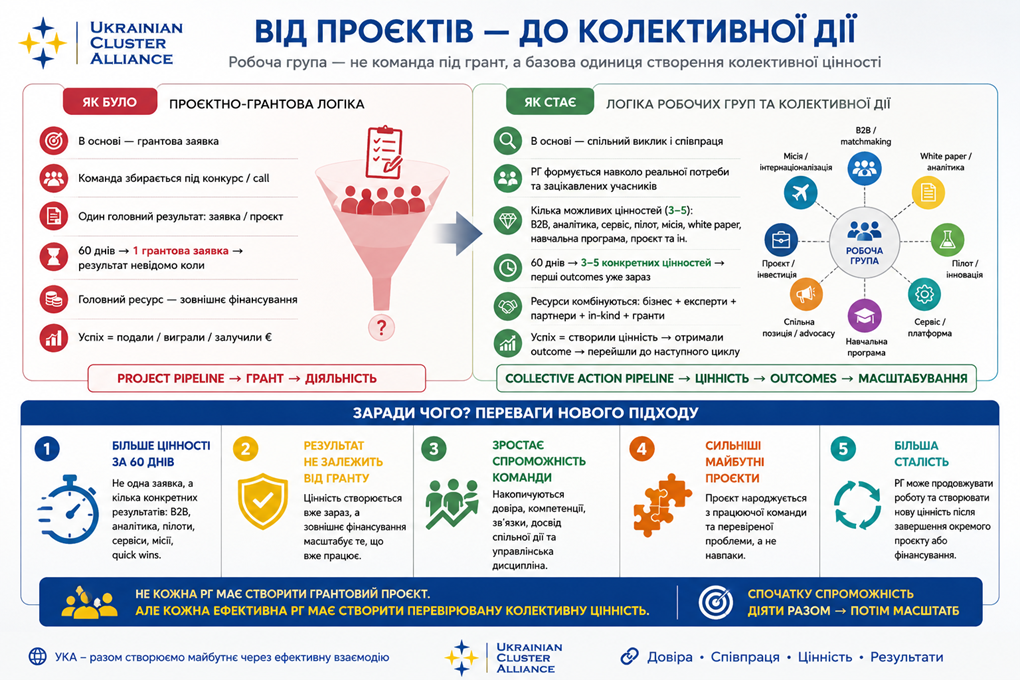
Infographics on this topic illustrate the ideas of the article in more detail.
In a previous article, for participants in the Clusters Project Management Excellence Program, we have shown that the ideology and practices of ALL (Agile Lean Leadership) unfold the logic and approaches to cluster work almost on 180 degrees:
- At the heart of the merger in the WG – Common market challenge and the realization that we can only accept it together – not a grant application to be submitted to increase our income)
- The result of the work of the WG – There is a rapid generation of a number of values for the community – not a mythical grant is unknown when. The format we are setting up now is a demonstration of 3-5 significant results in 60 days.
- The main resource for achievement is not external funding, but the ability of participants to act together. And where internal energy, proper organization, competence and professionalism are in the foreground, and external funding only reinforces these factors.
Infographics on this topic illustrate the ideas of the article in more detail.
Well, – isn’t this a fantasy, you say? Where are examples of such a quick start, and which can generate collective value for the community so quickly?
These days, the front office of Kyiv EDH has summed up the first results of its work in the new lineup for the last 2 months. In ALL, we have a team and its results in 60 days. Let’s look at them.
Practical Case Front Office Edih Kyiv Hitech
The front office of the EDIH Kyiv Hitech (hereinafter simply the ‘Hub’) is the only structure from UCA, which includes the Customer Journey (Client Route of Digital Transformation) and provides leads and client cases of all other (8) participants consortium. That is, the hub has 2 key roles
- Strategic – Ensuring the Customer Frist principle in the consortium through the formation of a constant and sustainable focus on customer needs, as well as the strategic orientation of the consortium on the compliance of the service portfolio with market demand
- Tactical – generation of a stable flow of client requests (lides, specific cases) to launch the entire service ecosystem of the hub.
The front office now includes 5 people – director, digital support manager and 3 KAM (Key account managers), as well as communications manager. There are more vacancies for the head of the project office for fundraising and the manager of attracting clients. In essence, we are considering the format of the new team, which was launched only in June, and where most of the processes are still at the installation stage.
So what did you manage to achieve in July-August?
The main result – began regular, systematic work with the market. First of all, the front office focused on industrial segments. During this period
- Promotion – external activities. 1 large brokerage event in the agro-food industry and 1 corporate mini-hackathon was held. The front office also supported the holding of the 1st offline workshop of the hub, and the publication of the 1st White Paper (WG ‘Vertical Integration’). Along with partners from KPI, the preparation of hackathon in the industry has been launched 5.0
- Customer Focus – Analytics: 7 analytical reports and guides have been issued, which show the picture in the target market segments for different categories of participants. Online customer surveys have been launched.
- Debugging of internal processes, Methods and tools for all these: there are also a number of internal documents, the processes of working with 2 key support tools (Datamentio, Clickup).
- Formation of a service portfolio and ecosystem: In addition to debugging existing services from the hub, 5 integrators are attached to the catalog of external service providers.
- As a result of the above, – began to work Customer Pipeline: more than 50 leads and cases have been generated, and 20 have joined the targeted SME digital transformation program (Living Labs)
So, these are figures and facts about specific deliverables obtained in less than 2 months of work.
But this is not the main result.
Deliverables are important only when they change the ability of the team, the behavior of the participants or create a new value for the client and other steholders.
We can already distinguish at least six different types of value that this team creates.
1. New team capacity. An internal benchmark has been installed on the correct organization and demonstration of the team’s abilities – and which is broadcast on the entire hub. There is a regular rhythm: weekly sprints, three coordination meetings per week, clearly distributed roles, there is a single action plan and Clickup as a common control tool. This is the basis of efficiency, this is an example for other members of the consortium and it is the basis of effective interaction at the level of the whole consortium.
2.Market focus and principle of Customer First. Dozens of considered cases and market demands allow a) to start turning the logic of the whole hub with the Inside-Out (which was due to the initial nature of the preparation of the grant application), on the outside-in – and which is evidence of true client-centeredness. At the same time, 5 top trends of industrial customers are clearly identified, for which the entire service portfolio and involved providers are being restructured..
3. New knowledge, methods and standards. During July-August, a significant array of practical materials was created: both the regulation of internal processes and external tools. For example, the first brokerage event clearly highlighted the fact of low market awareness in all areas of digital technology. Then the front office initiated and led the launch of educational tools, and where white books are ahead. The first white book on MES / MOM is also the first noticeable joint result of the Vertical Integration WG, to the launch of which the front office team is also involved. We also see various analytical reports, guides for integrators and donors, audit methods, case routing tools and customer support, and so on.
4. New tools and mechanisms of interaction with the market. During this period, 2 important tools of Hack & Match – industry format (the first took place in the agro-food) and corporate level. These 2 tools are planned to be further scaled to other industries and enterprises. As for other tools, hackathon 5.0 is planned, and high hopes are also placed on Living Labs.
5. New Customer Journey. Detailed review of leads and cases together with other members of the consortium will allow to identify problems in the previous understanding of the processes of the client path and to make important changes. In particular, the Front Office has introduced a new process (Clinic Review), which allows to consider more broadly the possibility of implementing digital innovations in production.
6. Expansion of the service ecosystem. The front office acts as a trigger and the main initiator of the creation or restart of new WGs within the hub. For example, we have made a lot of efforts to create WG ‘Vertical Integration’ and Smart Energy, not because we like these topics so much, or for other reasons. The only and main reason is market demands in these areas as top priority. And then the whole chain of internal and external resources is formed for better maintenance. And in this process it is very important to achieve effective interaction of experts from different categories
Important lessons from Edih Kyiv Hitech front office for all RG UCA
Of course, you can immediately see the denial of individual readers or representatives of other WGs that such a team and such results are the result of funding the received EDIH Kyivhitech. But this is only partially true. Like all members of other consortiums, we are only 50% funded – we have to get the other 50% ourselves. Moreover, this 50% of the European Commission does not even cover the salaries of those employees who are already at the front of the office. Not to mention the activities – only the brokerage event for Agrifood cost us 200 thousand UAH. So where does the budget for this activity come from? In fact, this is a classic of clusters, as mentioned at the beginning of this article and in many teaching materials of UCA – a) business contributions (it was the members of APPAU who fully covered the 1st brokerage event), b) sales of services (already started), c) other sources (income from other projects, etc.).
Summarizing all this experience in recent months, there are 5 main lessons
- Team discipline is more important than resources. In conditions of constant uncertainty, this factor means no less, and sometimes more than a good plan or organization of work.
- Adaptability is more important than the original plan. This is a well-known rule in the Agile rule, we are now going through again and again on our own experience. De facto, the front office sets the rhythm and directions of hub change in many areas – from interaction formats to the entire service portfolio.
- Focus of common standards and scalability. From the beginning, we keep the course on high scalability – processes, tools, services, etc. The tools of market attraction such as Hack & Match, hackathons, Living Labs – should become the standards of the hub. But if we summarize – the standardization of tools, common methods and scaling – this is, in our opinion, one of the key missions (assignments) of any working group. And here once again it is worth mentioning the large number of grant projects that do not create and leave almost nothing.
- Practical orientation and perception by the team are more important than correct regulations. We also saw that it is not worth abusing the ease of creating new content or documents with the help of AI. There is a certain threshold at which the ability to accept new information, and even more so reconfiguration in teams from different organizations, takes time – sometimes much more than we think. And now we are changing some approaches: first a real client case → a short hypothesis → test on 3-5 other cases → a simple rule → and only then the full regulations. But again, this is the basis of working in WG and small teams, as we see.
- Well, the main lesson – in these examples we see how it really turns on conveyor (pipeline) collective value and collective action:
Team → Coordinating on practical cases → New level of interaction → Service → Result for Outcome client → New cycle.
Of course, it is too early to talk about successes or some completed and significant results of the hub’s work. The front office team, and even more so the whole hub, has many internal obstacles and problems that need to be addressed. At the same time, the accepted pace, approaches and first results will allow us to look to the future more confidently.
And in our opinion, this example is quite relevant for demonstrating how the principles of ALL work in practice, we point out several main ones:
- Basically, a strong, well-coordinated team where roles and tasks are clearly distributed
- The team has goals and backlog: the goals and objectives of the front office are defined by the hub plans, and then there is a decomposition and a work plan for 2+ months with specific tasks for each participant
- Adjusted management rhythm and sprints on a weekly basis.
What will your RG show in 60 days?
These days, about 20 new WGs will start within UCA. And so this is the main issue that we want to address today to other working groups of Clusters4regions, Clusters4X and also other WG Hub (Edih Kyiv Hitech).
The main recommendation – do not follow the template – ‘What big project will we have time to write and submit to the competition on October 10?’
Start with two correct questions:
- What is the portfolio of specific Deliverables that we are able to create together in the next 40-60 days?
- What will the Outcomes of these results be in the next 60-90 days?
it could be a new white book or another enlightenment instrument or a series thereof; effective brokerage (or matchmaking) event, which generates dozens of combinations and interesting, high-quality B2B cases and follow-ups; adjusted audit methodology and new quality of auditors; creation of a new service and the first clients on them; an international mission that generates new partnerships and consortia, etc. And of course – writing a new grant application, but consider it as ‘one of ..’ – not the only and main result. This is how the working group ceases to be a ‘grant team’ and becomes the basic unit of collective action: a team that at the same time creates value today and increases its own ability to create even greater value tomorrow.
First, the ability to act together. Then – the scale.