



Or why the development of coordinator skills becomes the number 1 growth zone for Ukrainian clusters
Since 2024, the Ukrainian Cluster Alliance has paid much attention to working groups as basic mechanism of collective action in clusters. In 2026, this thesis became the basis of the operating model of the cluster organization and we consolidated it with special training Clusters PM Excellence, where more than 20 managers received certificates in the development of Agile Lean methods Leadership. That is, we consciously and purposefully shift the emphasis from the model ‘Cluster = organization that acquires and implements grant projects’ to the model where the cluster regularly creates collective value: new services, partnerships, technological pilots, analytics, international projects, joint solutions. and where the main mechanism of interaction are effective working groups (WG). The practice of the new 20+ working groups created after the training very quickly showed the following bottleneck: The Growth Zone today is the capacity and skills of managers leading these groups.
We call this role Cluster Pilot, where ‘cluster’ is any organized community that has common interests and goals.
So, at the training, we reached a consensus that Cluster Pilot (or WG coordinator) is not a WG secretary, it’s not necessarySurely the best industry expert, and this is not a classic project manager. From the methodology srcum / agile is rather a Scrum Master profile, which so far has almost not manifested itself in cluster organizations. Its main product is an environment in which independent organizations and people are able to negotiate, take responsibility and regularly create a common value. This is how this problem was formulated according to the results of the Clusters PM Excellence program.
Now we see that this is super important for clusters – a number of WGs give us weak results, precisely because of the lack of strong, trained coordinators. After all, the WG coordinator has no administrative power over the participants. A representative of an enterprise, university or other organization cannot simply say, ‘I am your head – do it.’ Therefore, a fundamentally different set of managerial and personal skills is needed here.
Next, we will analyze these skills in accordance with self-diagnosis tool, which is now launching UCA.
Three Typical Cluster Pilot Patterns and Traps
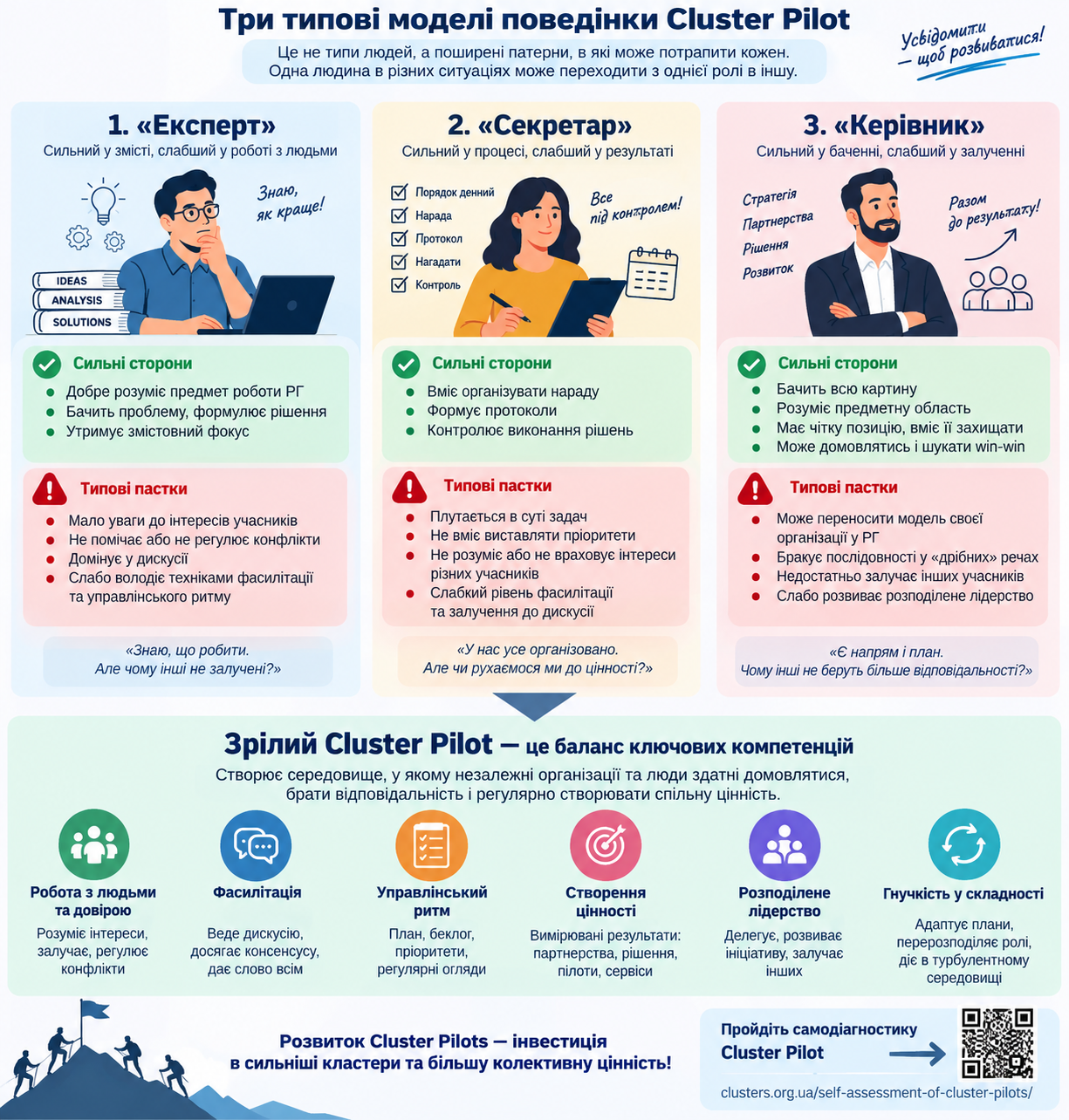
According to our observations, today we can see at least three typical patterns of behavior. These are not ‘types of people’ and even more so not an assessment of specific individuals. One person in different situations can move from one model (role) to another. it’s rather Patterns of typical behaviors and growth zones.
Pattern No. 1 – ‘Expert’
The expert understands the subject of WG’s work well. He sees a problem, able to formulate a solution, maintains a meaningful focus. But there is a trap here – The subject of work begins to replace work with people.
The expert can perfectly explain that It is necessary to do, but it answers the questions much weaker:
- what different participants want;
- where their interests do not coincide;
- why someone is silent or stopped coming;
- how to prevent the dominance of 1-2 active people;
- how to turn a conflict of positions into solutions;
- Who is really ready to take responsibility.
As a result, the WG is gradually becoming a group of people around one or two strong experts – leaders.
This directly corresponds to the two blocks of our self-diagnosis – Team and Trust and Facilitation: Cluster Pilot should check the motivation and expectations of participants, create an opportunity to talk about conflicts of interest, ensure the participation of different parties and help the group to make decisions independently.
Pattern 2 – ‘Secretary’
This is the opposite case. A person is able to organize a zoom-when, send out the agenda, hold a meeting, write a protocol, remind about the decision.
Everything looks organized. But there is another problem: There is a process, and there is no movement towards value.
Such a coordinator often cannot answer:
What three things are really a priority for the WG right now? What should we do less or stop altogether? And where – to increase efforts? What specific result should we show in two weeks? And what value will the participants receive in 60-90 days?
Therefore, ten well-protocold meetings do not mean effective WG. A separate block is devoted to this in self-diagnosis ‘Performing and creating collective value’: Each work cycle should have a tested result, key actions – responsible and time, and progress should be evaluated not only by the number of tasks performed, but by created partnerships, solutions, pilots, services or analytical products.
Pattern №3 – ‘Head’
He is often a strong and experienced person. She sees the whole picture, understands the subject area, has a position, is able to argue it, negotiate and find compromises. The problem begins when the leader unconsciously transfers the model of his organization to the WG – ‘I know the direction (as it should be) – the rest should be organized around it’.
In fact, there are no boss and subordinates in the WG. Needful Distributed leadership: Responsibility for results, meetings, experiments and individual areas gradually passes to different team members. It is this behavior that is embedded in the ‘facilitation and distributed leadership’ block of our diagnostics. Otherwise, a strong leader can paradoxically create a weak WG: as long as he moves the process, everything works. As soon as he leaves, everything stops.
According to the UCA Directorate, this is the reason for weak inter-cluster cooperation in the Alliance. And because of the lack of strong Cluster Pilots, we can’t launch these inter-cluster WGs.
What all three models are missing
Despite the differences, in these three cases we see a very similar set of growth zones.
The first is facilitation. It’s not just a ‘good meeting.’ It is the ability to attract different voices, hear interests, make differences visible, do not avoid conflict, but also not allow it to destroy the group, help participants make decisions themselves.
The second is working with trust and interests. Before starting work, you need to understand the motivation, expectations, possible contribution and limitations of each participant. In a mature WG, we can openly talk not only about successes, but also about doubts, unfulfilled agreements and conflicts of interest. Such criteria are embedded in the tool of self-diagnosis.
The third is the management rhythm. A good WG has a transparent list of priorities, agreements, risks and obstacles; short work cycles; clear responsible; Regular review of progress.
The fourth is effective internal communication. Cluster Pilot must be able not only to capture the decision, but also to understand why it is not executed: no motivation? resources? powers? A new priority has arisen? Does a person simply not feel responsible? The coordinator’s task is to remove systemic obstacles, not to constantly take someone else’s work.
PYata – the ability to work with complexity. In a turbulent environment, a good plan quickly becomes obsolete. Therefore, Cluster Pilot must be able to distinguish between situations where a ready-made solution works and situations where an experiment is required; break large intentions into short cycles and change the plan after receiving a new reversecommunication.
And finally— focus on collective value. The Cluster Pilot question at the end of the month should not sound like “how many meetings have we held?” but:
What collective value have we created because this group worked together?
It can be a new partner, joint decision, application, service, prototype, business case, market access, analytics or change of certain practice. Infographics below summarize all of the above (Fig. 1).
How to develop these skills
During the training, we paid much more attention to the overall development of Agile Lean Lean Leadership tools – as approaches and stages to creating WG, sharing roles and building trust and verification tools. All this is reflected in detail by Hyde ‘How to create effective working groups.’ However, we did not go in detail, and in fact it was not a goal – growth of practical skills of WG coordinators. Meanwhile, it was at the end of the training that it became clear that this is now the growth zone 1.
So how do we increase this level now?
We may need 1 more training, but we know from experience thatAnother course alone does not solve the problem”. Practice decides. Things such as facilitation, conflict management, prioritization or delegation (for distributed leadership) cannot be learned from theory – these methods and techniques must be constantly practiced. There are more than enough reasons for this in the framework of the running WG. After all, each WG should at least meet weekly and record progress for the next iteration (sprint). Here are 3 main methods available for all UCA coordinators
- Self-study and self-improvement – through the provided materials (training materials, checklists, self-diagnosis, ready-made WG concepts for some groups, etc.) and constant practice. In general, these inputs are more than enough to start systematic work, and the question rather is whether you use them or not. For example, the UCA Directory clearly shows that some coordinators continue to ignore ‘simple things’ – such as backlog, clear distribution of roles in the WG, clear task statements for each participant, regular protocols and reporting on the solutions, etc. No new training will help this – only practice and discipline. And it is important for all participants to understand their own level in this area – for this there is a new tool
Cluster Pilot self-diagnosis
This will help you understand your own growth zones quickly.
- exchange of experience and best practices. The UCA Directorate provides opportunities for regular exchange of practices in this area. It is now happening every 2 weeks within the Clusters4regions project, but given the strategic importance of this direction, we will continue to do so, and outside of any grant projects. It is important to know that right now in most WGs there is support at 2 levels
- From a group of more experienced colleagues – mentors and coaches Clusters4regions
- Foreign Trust Mediators Consultants who are still available to us and want to work on Ukrainian clusters
- Stimulating rapid growth In this area, it is also carried out within the framework of the Clusters4regions project by organizing a competition for the best projects and initiatives that come from 20+ PG.
In general, even after passing Self-diagnosis We recommend focusing on 1-2 growth zones, then practicing them for 2-3 weeks in real WG – to get reversecommunication from your mentor or group curator, then go through a retrospective and re-diagnosis. Together – this will give a rapid growth of relevant skills, which are now in short supply.
For example, if facilitation is facilitating, you do not need to go through another ten hours of theory. You need to set yourself the task of conducting yourself – facilitation of the following 3-4 meetings with specific goals: ‘I enter the role of the presenter, I will say less – but I will follow the agenda, ensure the participation of all, record differences, and the decision will be formulated by the group itself.’
If the problem is the management rhythm: to introduce 2-3-week cycles, a short list of priorities, responsible, the expected result of the cycle and retrospective.
If the weak point is, trust: to hold individual conversations with key participants about their interests, expectations, restrictions and reasons for non-compliance.
If the problem is excessive control: for the next cycle knowingly transfer responsibility to another participant a single outcome or a single meeting.
summarizing, the Cluster Pilot training unit should be Real change of one’s behavior in the next work cycle.
That is why the logical next step for UCA is to form Cluster Pilots Practitioner Community: real WG as training laboratories, peer-review between coordinators, analysis of typical cases, mutual observation of facilitation and short regular retrospectives. This approach also corresponds to the conclusion of Clusters PM Excellence – the next stage should be built as training through practice around real workgroups.
So, are you ready? Take the test for link and identify your own practices in eight areas: Role, trust, facilitation, work with complexity, value creation, communication, behavioral risks and readiness of the WG environment. In total, these are 40 statements, and the result will be the profile of your development zones. Next – identify 1-2 zones that you hire. Discuss these things further with your mentor or curator and outline a specific plan of action.
The culture of cluster cooperation does not change when we have read the right Playbook or Hyde. It changes when the WG coordinators begin to behave differently in real teams.